
Monday, April 25, 2016

Sunday, April 24, 2016
Sixth Extinction
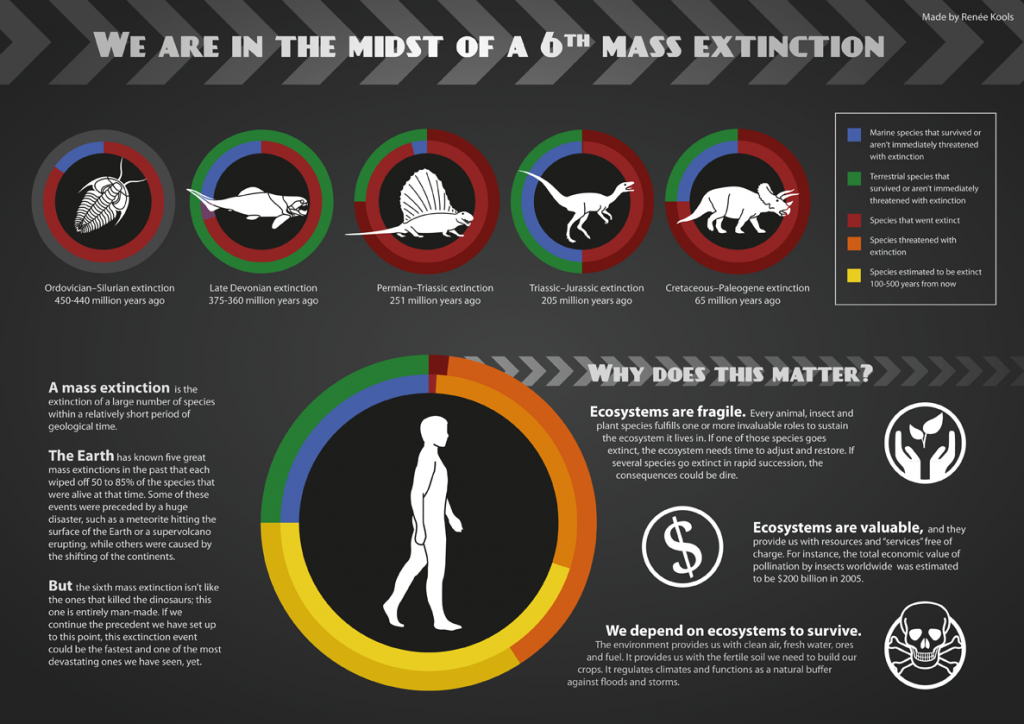 I presented on the sixth extinction. However, to first talk about that, I needed to teach the class about the previous five extinctions. After describing each extinction I finally jumped into what the sixth extinction was. It is us. The class was very interested to learn about how one day, we as humans could be gone. I taught the class on how we as humans are effecting our earth in a negative way. We are destroying nature, the oceans, and organisms. This is going to lead our extinction, not a asteroid but possibly a famine or some sort if we continue our approach. Finally I used a very helpful video that explained the sixth extinction and how we effect everything around us that will lead to the sixth extinction.
Sunday, April 17, 2016
El Yunque National Forest
In 1876 King Alfonso XII of Spain set aside acres of land. In 1903, that land was established as the Luquillo Forest Reserve by the General Land Office. Three years later, the land became a national forest and then renamed to the Caribbean National Forest in 1935. 72 years later, George W. Bush changed the name to El Yunque. This was to embrace the culture of Puerto Ricans. This was an executive order, and Bush had the right to since Puerto Rico is a territory of America, and is the only tropical forest protected by the United States National Forest system. El Yunque has a tropical climate and it rains on average of four times per day. The temperature ranges from 70-80 degrees so it is always perfect growing conditions for plants. Throughout the 29,000 acres of land, there are over 200 species of trees and animals. Also. the forest is divided into four different zones depending on the high above or below feet. Today, visitors to El Yunque can go camping, hiking, nature viewing, climb next to waterfalls, and swim in natural streams of water. And for the locals, their are hidden spot where people can go water sliding down rocks and swim in a pool made directly from stone.


Friday, April 15, 2016
Lake Poopo Bolivia's Second Largest Lake
Lake Poopo has since dried up and was once Bolivia's second largest Lake. The Lake's state has been blamed on El Nino, climate changes, and mining pollution. Due people not caring for the lake, some fear that it may never return, while others believe it will take twenty years. The drying up of the lake was a process that should have taken 2,000 years from present day. People who once used the lake for fishing as a source of food, had to go elsewhere. Species in the water died, along with the species that went to the lake to drink water and look for food. Now the Lake is nothing but dried up land. Governments should have taken much better care of the lake in order to prevent it from drying up. Hopefully in the future the lake will either return or we find a way to fix it.

Monday, April 11, 2016
GMO BLOG
For my Friday Symposium, I created a presentation on Genetically Modified Organisms. The first GMO to ever be created was in 1973 by two biotechnologists, Herbert Boyer and Stanley Cohen. Both of these scientists were extremely important in the start and development of trade arch for GMO’s and we're both awarded National Medals of Science for their hard work. Another important scientist in the research of GMO’s was Rudolph Jaenisch, who used information he got from performing experiments on mice to benefit humans. People have had mixed opinions on the use of GMO’s since they were first introduced to the world. Some of the benefits or Pros of the usage of GMO's are that they can limit pollution, provide nutrients for humans, and cure diseases. On the other hand, some negatives or Cons of the usage of GMO’s are that they can reduce the effects of antibiotics and cause genes to spread. Overall, I believe that GMO’s can be a good thing if they are used correctly. If not, then they can certainly be dangerous which should encourage scientists who use them to use them cautiously.
Saturday, April 9, 2016
The Appalachian Trail
The Appalachian Trail can either begin from two different locations. If you would like to start in Maine, you begin in Mount Katahdin and you will end in Springer Mountain in Georgia. Surprisingly the trail stretches to approximately 2,200 miles along fourteen states. There are many different types of species that are located on the trail. Animals include, the American Black Bear, ticks, rattlesnakes, moose, and elk. Depending on the location on the trail, there are a variation of plants on the trail. In the south you can find, oak, tulip trees, and Appalachian Balds. On the other hand, in the north you may find maple, birch, and beech trees. Hikers usually are offered homes to stay the night when they are completing the 2,200 mile hike. A hiker can also stay at a camp but they would have to reserve a spot. Hikers usually begin to walk the trail in March or April and they end in late August. Only 15,000 people have successfully completed the trail.


Tuesday, April 5, 2016
Love Canal
Subscribe to:
Posts (Atom)